

For many small businesses, a website represents a frustrating paradox. It’s one of the most critical assets for growth, yet it often feels like a depreciating one. Many companies find themselves trapped in a costly “refresh cycle,” forced into a complete, expensive website rebuild every three to four years just to keep up with changing technology and design trends. In today’s uncertain economic climate, this model isn’t just inefficient; for a growing business, it’s unsustainable.
The gap between a modern, high-performance website and a legacy one is no longer a crack; it’s a chasm. An outdated digital presence is more than an embarrassment—it’s a liability that actively damages your bottom line. Research shows that every one-second delay in page load time can slash conversion rates by up to 20% on mobile devices, and more than half of your potential customers will abandon your site if it takes longer than three seconds to load.
The solution is to stop thinking of your website as a disposable brochure and start treating it as a strategic, long-term asset. The key is future-proofing: a strategic approach to web development that prioritizes scalability, flexibility, and intelligence. It’s not about chasing fleeting trends; it’s about building a resilient digital platform that grows with your business, saves you money in the long run, and forges a powerful, sustainable competitive advantage.
Here are the seven essential strategies that will define the line between thriving and surviving in 2026 and beyond.
Strategy 1: Embrace AI as Your Core Development Partner
Artificial Intelligence has moved from a “nice-to-have” novelty to a fundamental component of the modern development toolkit. Its integration is becoming so deep that by 2026, it’s projected that 90% of all new website code will be written with AI assistance. For small businesses, this isn’t a threat; it’s the single greatest opportunity to level the playing field.
How AI Future-Proofs Your Website:
- Drastically Faster Time-to-Market: AI-powered tools like advanced code generators can write entire functions from a simple prompt, while AI-driven testing can predict and identify bugs far faster than a human can. This dramatic boost in productivity allows smaller teams to build and launch sophisticated, robust platforms in a fraction of the time and at a lower cost, enabling them to seize market opportunities before slower competitors.
- Proactive Security and Maintenance: A future-proof website is a secure one. AI algorithms constantly monitor your application, predicting and identifying security vulnerabilities in real-time. This shifts security from a reactive, patch-based approach to a proactive defense, protecting your business and your customers’ sensitive data from emerging threats.
- Data-Driven Optimization without a Data Scientist: AI-powered analytics can interpret complex user data and offer actionable insights into how to improve your website’s performance. This allows you to make smarter, data-backed decisions to enhance user experience and increase conversions without the overhead of a full-time data analyst.
For a business, the value isn’t just in using AI to write code. It’s in having a technology partner who can strategically orchestrate a suite of AI tools with expert human oversight to build a truly superior digital product. This is the core of a “Smart Tech” approach—leveraging intelligent technology to deliver exceptional performance and tangible business results.
Strategy 2: Prioritize Blazing-Fast Performance with Core Web Vitals
In the digital economy, speed is currency. A slow website doesn’t just frustrate users; it actively bleeds revenue. Google’s research and industry data are unequivocal: a fast, responsive website is one of the most powerful drivers of business growth.
To standardize the measurement of user experience, Google introduced Core Web Vitals, a set of three specific metrics that are now a direct factor in its search ranking algorithm. A site that excels in these areas not only provides a better experience but is also rewarded with greater visibility.
Demystifying Core Web Vitals for Business Owners:
- Largest Contentful Paint (LCP): How fast does your main content load? This measures the time it takes for the most meaningful content on the page (like a hero image or the main headline) to become visible. A good LCP is 2.5 seconds or less.
- Interaction to Next Paint (INP): How quickly does your site respond? This new metric measures the delay between a user’s action (like clicking a button or tapping a menu) and the visual response from the page. A good INP is under 200 milliseconds.
- Cumulative Layout Shift (CLS): Is your site visually stable? This measures how much the page layout unexpectedly shifts or “jumps around” as it loads. A low score is better, with the goal being less than 0.1.
Failing to meet these thresholds has a direct and measurable negative impact on your business. The modern user has no patience for lag, and the financial consequences are stark.
| Performance Metric | The Business Impact of a 1-Second Delay | Source(s) |
| Mobile Conversion Rate | Can decrease by up to 20% | [9] |
| Overall Conversion Rate | Can decrease by 7% | [10] |
| User Satisfaction | Decreases by 16% | [9] |
| Bounce Rate Probability | Increases by 32% (from 1s to 3s load time) | [9] |
Optimizing for Core Web Vitals is a technical discipline, involving everything from image compression and code minification to efficient server response times. However, the outcome is purely business: a faster site leads to higher rankings, better engagement, and more conversions.
Strategy 3: Build for Flexibility with Headless & Composable Architecture
One of the biggest hidden costs for small businesses is the “monolithic” nature of traditional websites. In a typical setup, the front-end (the visual design users see) is rigidly coupled to the back-end (the content management system, or CMS). This means that a significant design update, a new mobile app, or an expansion into new digital channels often requires a complete, costly, and time-consuming rebuild of the entire system.
Future-proof development breaks this cycle by decoupling these components, offering unparalleled flexibility and long-term cost savings.
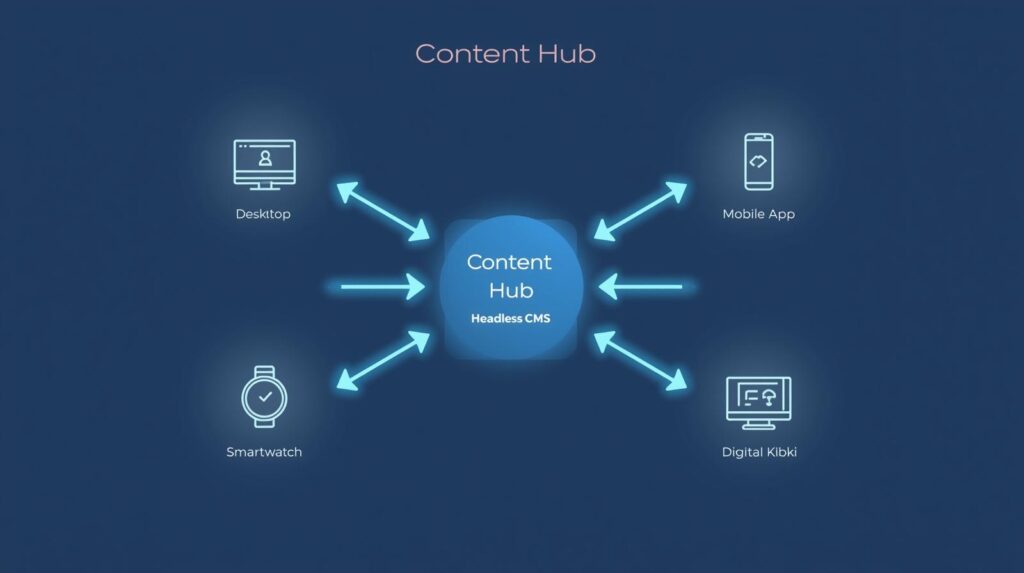
- Headless CMS Explained: Imagine your website’s content (blog posts, product descriptions, images) lives in a central “brain” (the back-end). A headless CMS separates this brain from the “face” (the front-end website design). It delivers content via an API, which is a universal language that any application can understand. This means you can create your content once and deliver it seamlessly to a website, a mobile app, a digital kiosk, or even a smart-watch—all without rebuilding the back-end. This is the foundation of a true omnichannel strategy.
- Composable Commerce Explained: For e-commerce businesses, this concept goes even further. Instead of relying on a single, all-in-one platform that does everything “good enough,” composable commerce allows you to build your digital store with best-in-class “LEGO bricks”. You can plug in the absolute best solution for search, a different one for payment processing, and another for your product catalog. If a better tool comes along, you simply swap out that one brick without demolishing the entire structure.
This architectural approach provides ultimate agility. It prevents “vendor lock-in” and ensures your digital platform can evolve, scale, and adapt as your business grows and technology changes. This transforms your web presence from a recurring capital expenditure (the dreaded rebuild) into a manageable operational expenditure focused on continuous, incremental improvement—a far more sustainable and strategic model for any growing business.
Strategy 4: Automate Workflows to Drive Efficiency and Growth
A future-proof website is not a static, isolated digital brochure. It is a dynamic, deeply integrated hub of your business operations. By connecting your website to your other business tools, you can automate repetitive tasks, eliminate human error, and free up your team to focus on high-value activities that drive growth.
Practical Website-Driven Automation for Small Businesses:
- Intelligent Lead Qualification: A visitor submits a “Contact Us” form on your site. Instead of just sending an email, an automation can be triggered. This workflow can enrich the lead’s data with company information, score the lead based on predefined criteria (like industry or company size), and if the score is high, automatically create a deal in your CRM and assign it to a sales representative. This ensures your sales team only spends time on the most qualified prospects.
- Seamless Customer Onboarding: When a new customer signs up through your website portal, it can kick off an entire onboarding sequence. An automated workflow can instantly send a personalized welcome packet, generate a service agreement for e-signature, and schedule a kickoff call, creating a professional and efficient first impression without any manual intervention.
- 24/7 Customer Service: AI-powered chatbots integrated into your website can handle the top 5-10 most common customer inquiries instantly, day or night. They can access a knowledge base to provide answers, and for more complex issues, they can collect information and create a support ticket, ensuring a seamless handoff to a human agent. This improves customer satisfaction while reducing the burden on your support team.
This level of integration and automation directly addresses the resource constraints that challenge most small businesses, allowing them to operate with the efficiency and scalability of a much larger organization.
Strategy 5: Deliver Hyper-Personalized Experiences (Without Cookies)
For years, digital personalization has relied on third-party cookies to track users across the web. That era is ending. Browsers are phasing out these cookies, rendering old methods of tracking and targeting obsolete. The future of personalization belongs to businesses that can build direct relationships with their audience and effectively leverage the data they collect themselves.
Your Website as a First-Party Data Engine:
A modern, future-proof website is the most powerful tool for gathering first-party data (information from user behavior on your site) and zero-party data (information users willingly give you). This is achieved through:
- Interactive Content: Quizzes (“Find your perfect software solution”), surveys, and product configurators not only engage users but also capture invaluable preference data.
- User Accounts & Preference Centers: Encouraging users to create accounts allows them to save their preferences, creating a rich profile that can be used to tailor their experience.
- On-Site Behavior: Tracking which pages a user visits, how long they stay, and what they click on during a single session provides powerful real-time signals of their intent.
AI-powered personalization engines can then use this ethically collected data to transform the user experience in real-time. Imagine a website that dynamically changes its homepage banner, product recommendations, and even calls-to-action based on a visitor’s industry, their previous purchases, or the content they’re currently viewing. This level of relevance drives significantly higher engagement and conversion rates. In the cookieless future, a website is no longer just a marketing channel; it is a strategic data-generation asset that provides a deep, sustainable competitive advantage.
Strategy 6: Prepare for the Immersive Web with WebXR and 3D
While still an emerging technology, the immersive web is poised to become a mainstream expectation by 2026. WebXR (which stands for Extended Reality) encompasses Augmented Reality (AR) and Virtual Reality (VR) experiences that run directly in a web browser, crucially requiring no separate app download. For businesses that get ahead of this curve, the opportunity to create unforgettable customer experiences is immense.
Tangible Business Use Cases for WebXR:
- E-commerce (“Try Before You Buy”): An online furniture store can allow a customer to use their phone’s camera to place a virtual sofa in their own living room to see how it fits and matches their decor. A fashion brand can let a user virtually “try on” a pair of sunglasses. This dramatically increases purchase confidence and reduces costly returns.
- Real Estate and Hospitality: A real estate agency can offer immersive, 24/7 virtual tours of properties, allowing potential buyers from anywhere in the world to walk through a home.
- Manufacturing and B2B: A company selling complex machinery can provide an interactive 3D model on their product page, allowing engineers to explore every angle and component in detail.
Adopting these technologies early moves a brand from simply telling customers about their products to letting them truly experience them. This creates a level of engagement and differentiation that flat, 2D websites simply cannot match.
Strategy 7: Make Accessibility and Security Non-Negotiable
In the past, web accessibility and security were often treated as afterthoughts—technical compliance checkboxes to be ticked off before launch. A future-proof strategy recognizes them for what they are: foundational pillars of customer trust, market expansion, and brand reputation.
- The Business Case for Accessibility: A website that is accessible (compliant with standards like WCAG) is usable by people with disabilities. This isn’t just the right thing to do; it’s smart business. It opens your products and services to a wider audience and is increasingly becoming a legal requirement in many jurisdictions. Building accessibility in from the start is far more cost-effective than retrofitting it later.
- The Business Case for Security: With data privacy regulations like GDPR and CCPA becoming stricter, and consumers becoming more aware of how their data is used, transparent and robust security is a powerful competitive advantage. A secure website—one that uses HTTPS, has a clear privacy policy, and is built on a secure architecture—tells your customers that you value and protect their information. This trust is harder to earn and easier to lose than ever before, making security a cornerstone of long-term customer loyalty.
Conclusion: Your Project, Our Responsibility
The digital landscape of 2026 will be unforgiving to those who stand still. An outdated, passive website is no longer just a missed opportunity; it is a significant business liability. The seven strategies outlined above are not isolated tactics but interconnected components of a single, essential mission: transforming your website from a cost center into your most powerful engine for sustainable growth.
A future-proof website is intelligent, fast, flexible, and secure. It automates your operations, personalizes customer experiences, and opens doors to new, immersive ways of engaging your audience. It is a strategic asset that builds a deep, defensible moat around your business.
To help you assess where your current website stands, use this simple checklist.
| Checklist Item | Does Your Website… |
| 1. AI Integration | Leverage AI for development, security, and data-driven insights? |
| 2. Performance | Consistently load in under 2.5 seconds and score “Good” on Core Web Vitals? |
| 3. Flexibility | Use a headless or composable architecture to avoid costly rebuilds and enable omnichannel delivery? |
| 4. Automation | Integrate with your core business tools to automate workflows like lead qualification and customer onboarding? |
| 5. Personalization | Have a strategy to collect first-party data and deliver personalized experiences in a cookieless world? |
| 6. Immersive Tech | Have a plan to incorporate 3D or AR experiences where they can add significant value? |
| 7. Foundations | Meet modern standards for accessibility (WCAG) and security (HTTPS, transparent privacy policies)? |
Implementing these strategies requires more than just code; it requires deep expertise in technology, strategy, and user experience. At DevAon, we don’t just build websites—we build resilient digital assets designed for growth. Let’s have a conversation about how we can make your website your greatest competitive advantage. Your Project, Our Responsibility.